Hatchet
Life of PiThe Hatchet belongs to the lifeboat’s survival equipment, where it serves as a working tool for obtaining and preparing food. Its role is defined less by a single use than by repeated encounters in which survival demands that Pi turn unfamiliar, difficult tasks into actions he can carry out.
Inventory and Place Among the Supplies
The lifeboat locker contains two hatchets, placing the Hatchet among equipment intended to support survival rather than rescue alone. The same inventory includes fishing kits with hooks, lines, and sinkers; two gaffs; two sea anchors; rain catchers; and a large hunting knife with both a sharp edge and a sawtoothed edge. Together, these supplies establish the practical setting in which the Hatchet is used: Pi has tools, but their presence does not make the work easy or remove the need to learn how to use them.
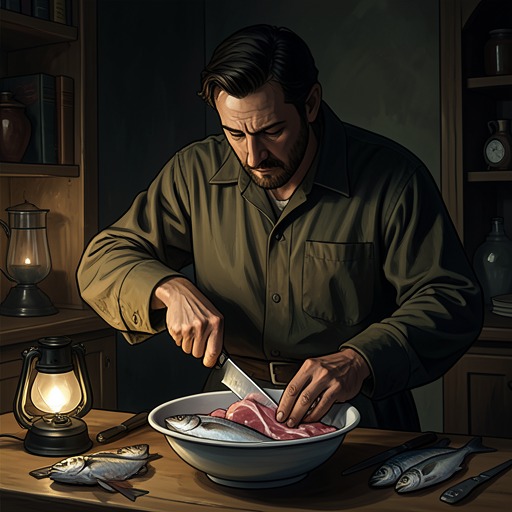
The Hatchet is distinct from the hunting knife, which is specified as having a pointed end and two different edges. In Pi’s early attempts to kill a flying fish, he raises the Hatchet but cannot bring it down, then considers using its blunt end and again stops. He finally kills the fish by bending it inside a blanket. The tool is available, but at this stage Pi cannot yet make himself use it against a living creature. That hesitation gives the Hatchet a place in the episode beyond its practical purpose: it marks the distance between possessing the means to survive and being emotionally prepared to act.
From Hesitation to Practical Use
After the flying-fish episode, the Hatchet becomes a more usable instrument in Pi’s hands. During a rush of flying fish pursued by Dorados, several fish end up in the Lifeboat, and Pi takes one to the raft. He initially cannot bring himself to use the Hatchet against it, but the delay only prolongs the fish’s suffering. That first killing unsettles him; the change that follows is not a sudden loss of feeling, but an adaptation to the demands of survival.
A Dorado gives the tool a different task. Pi catches one more than three feet long, with a hook embedded in its mouth, and uses the Hatchet’s hammerhead to kill it rather than its sharp edge. The fish is intended for Richard Parker, and dispatching it lets Pi retrieve the hook and part of his bait. He then places the catch in the Lifeboat and blows the whistle, reinforcing the association between food and his authority over Richard Parker. The episode makes the Hatchet part of a practical sequence: capture, preparation, feeding, and the maintenance of a precarious order aboard the boat.
Pi later uses the Hatchet while processing a Hawksbill turtle, whose blood he seeks because the Survival manual identifies it as drinkable. The task is difficult enough that he consults the manual as if it were a cookbook, but its directions do not map neatly onto the animal before him. He collects about 300 milliliters of blood, then uses the sawtoothed edge of the Knife to work around the shell; the Hatchet remains one tool among several rather than a universal solution. After preparing the turtle as food for Richard Parker, Pi retreats to the raft and recognizes that occasional tolerance from the tiger cannot guarantee safe access to the locker or tarpaulin. The episode links the Hatchet’s immediate function to a larger change: obtaining food sustains Pi, while the risks of doing so strengthen his resolve to claim territory.
Moral Cost and Adaptation
The Hatchet’s significance also lies in what its use does not erase. Pi’s first killing of a living fish leaves him distressed: he regards the act as a moral rupture, recognizes the fish in his prayers, and measures his former identity as a peaceful, religious boy against the fact that he has become a killer. The Hatchet had been present when he could not act; that hesitation makes the later shift in his conduct legible as an accommodation to necessity rather than proof that the earlier compassion was false.
With the Dorado, the same tool accompanies a markedly different response. Pi kills it to obtain food for Richard Parker and recover the embedded hook, and the capture brings him excitement and a sense of triumph. He reflects that people can become accustomed even to killing. The change is not simply that the Hatchet has become useful: the contrast between grief over the first fish and confidence with the later catch records how survival alters Pi’s conduct while leaving the memory of its moral cost intact.
Distinct Uses in Preparing Food
The turtle episode clarifies the Hatchet’s limits as well as its usefulness. Pi first considers using it to remove the shell, but finds the Hunting knife’s sawtoothed edge better suited to that work. The Hatchet instead serves at a later stage, helping him finish preparing the turtle after he has collected its blood. The Survival manual supplies general instructions, but the task requires Pi to judge which tool can do what; the Hatchet is one part of a practical division of labor, not an all-purpose answer to the difficulties of survival.